
Blog
CRQ in action

From pilot to capability: The journey to operationalise CRQ

Published on
May 13, 2025

Over the past five articles, we’ve explored the need for standardised metrics, how to make cyber risk quantification (CRQ) actionable, the mindset required to lead change, six core principles for doing it well, and the most common objections you’ll hear when trying to get started.

This is the final post in my blog series on CRQ, and the one that brings it all together.

CRQ can’t remain a pilot forever. To drive meaningful, repeatable value, it needs to mature into a business capability: trusted, embedded, and regularly informing decisions.

In this article, I share a four-stage CRQ maturity ladder. Each stage includes key actions to take, potential blockers (mapped to the objections covered in Blog #5), and traps to avoid. Together, these offer a roadmap to help CRQ evolve from a promising experiment to a business-critical capability.

Stage 1: Explore and Demonstrate Value

CRQ is still in its infancy. One or two champions are running a pilot, often with support from an external vendor. The focus is on modelling a handful of high-priority scenarios (typically ransomware) and using outputs informally to support broader conversations about cyber risk.

Actions to climb the maturity ladder:

  • Identify one or two influential allies to co-sponsor the pilot.
  • Run a workshop to answer: “What cyber event would disrupt our business materially?
  • Build a dashboard that contrasts CRQ outputs with traditional reporting and helps communicate uncertainty clearly.
  • Document assumptions in a shared location, or in your CRQ tool if it provisions for that.
  • Anchor early outputs in a consistent, decision-ready format — standard metrics build trust early (see Blog #1).
  • Use early CRQ outputs to support one real-world conversation (e.g. a board update, investment case).
  • Join CRQ communities or forums to accelerate learning and momentum.

Potential blocker:

"Isn't this too subjective?"

This is Objection 1 from Blog #5. Build credibility by grounding the pilot in a recent, well-known incident. Let people see that CRQ isn’t theory, it’s a structured response to real-world problems.

Common traps to avoid:

  • Overpromising accuracy — Position CRQ as directional, not definitive.
  • Treating outputs as final — The dashboard is a starting point, not the end product.
  • Skipping success criteria — Without clear goals, it’s hard to show impact.

Stage 2: Expand Use and Build Confidence

CRQ is no longer limited to a single team. A small scenario library exists. Outputs are starting to be routinely used to support real trade-offs (e.g. shifting investment between controls). Stakeholders across risk, cyber, and finance are engaged. However, questions start to emerge about consistency, governance, and alignment with existing risk frameworks.

Actions to climb the maturity ladder:
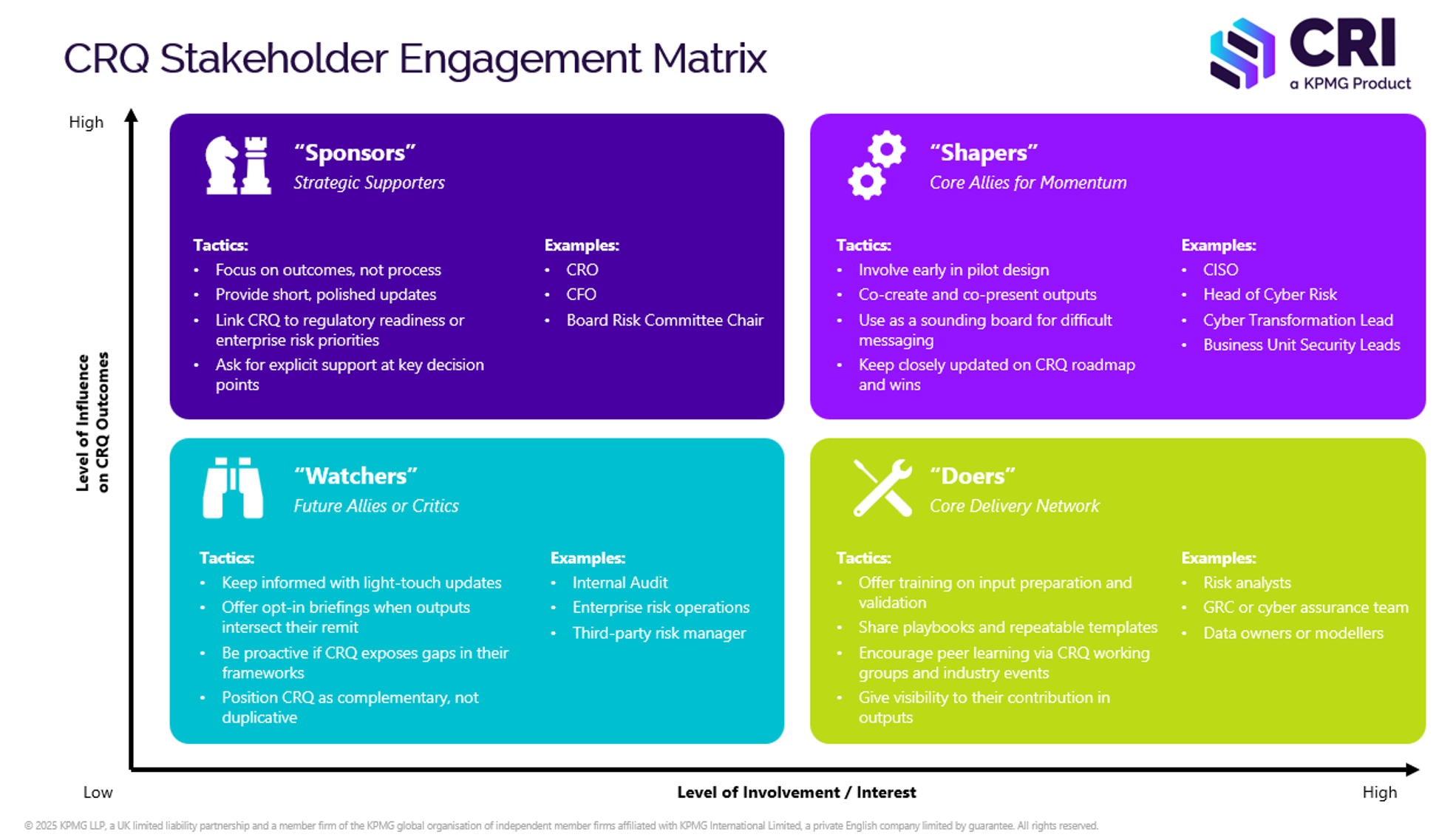
  • Build a stakeholder engagement matrix (see the below visual to aid your thinking).
  • Use CRQ to inform a real decision (e.g. prioritise spend, optimise cyber insurance).
  • Draft a six-month CRQ roadmap to clarify what you'll model and why.
  • Align analyses to a clear business objectives — ideally linked to areas like risk appetite or capital exposure.
  • Integrate CRQ outputs into governance decks (e.g. board updates, investment papers).
  • Create a lightweight review cycle, with a named challenger for each refresh.
  • Develop a reusable 'CRQ 101' explainer deck to onboard new stakeholders.
  • Translate CRQ outputs into language that aligns with enterprise risk frameworks.

Potential blocker:

What if this contradicts existing narratives?

This is Objection 4 from Blog #5. Start by showing alignment with current frameworks. Then use CRQ to add nuance where needed, not to replace what’s already working.

Common traps to avoid:

  • No socialisation Outputs may land flat if key people see them too late.
  • Misaligned with ERM CRQ might be side-lined if it jars with established risk views.
  • Too much jargon Translate CRQ into business terms to keep credibility.

Stage 3: Standardise and Operationalise

CRQ is now embedded in key decisions. Outputs inform business cases, investment boards, and capital planning. The process is repeatable, the language is clearer, and delivery is largely internal, with targeted support from CRQ providers as needed.

Actions to climb the maturity ladder:

  • Revisit Blog #3 and ensure practitioners are empowered and visible as change agents.
  • Publish a CRQ playbook: how you scope, model, validate, and communicate.
  • Launch a monthly CRQ working group with 5-8 champions across the business.
  • Embed CRQ into at least two standing decision forums (e.g. ops or board risk committees).
  • Align outputs with enterprise risk tools (e.g. risk appetite, tolerance statements, capital models).
  • Standardise reporting templates to promote consistent messaging.
  • Nominate a CRQ lead per function to support decentralised usage.
  • Revisit risk appetite use CRQ to test and tune thresholds.

Potential blocker:

How do we know it's accurate?

This is Objection 2 from Blog #5. Explain that CRQ is calibrated expert judgment — transparent, grounded in reference events, and consistently applied.

Common traps to avoid:

  • Siloed ownership — CRQ must be relevant across functions to deliver value.
  • Outdated estimates — Refresh at least quarterly or when risk conditions change.
  • Assuming understanding — Repetition, framing, and interpretation guidance are essential.

Stage 4: Embed as Capability

CRQ is now a business-wide capability. It supports enterprise risk, finance, resilience, and strategic planning. It has governance, rhythm, executive sponsorship, and visible impact. CRQ isn't a project, it's how the organisation talks about cyber risk.

Actions to climb the maturity ladder:

  • Formalise a CRQ operating model (governance, people, process, data and tooling).
  • Link scenario refreshes to annual planning, budgeting, and capital allocation cycles.
  • Build a CRQ performance dashboard (e.g. % of scenarios reviewed, decisions informed).
  • Review CRQ usage across teams to identify where it's landing well and where it isn't.
  • Refresh stakeholder engagement plans annually — as people, teams, and politics change.
  • Use CRQ to demonstrate alignment with DORA, NIS2, or resilience expectations.
  • Celebrate CRQ 'exemplars' across the business — behaviour reinforces maturity.
  • Reground the team in the six CRQ working principles (See Blog #4).

Potential blocker:

Isn’t this just business as usual now?

The risk here is complacency. Use the six CRQ principles from Blog #4 to assess whether the capability is staying sharp or drifting.

Common traps to avoid:

  • Automation without adoption — Process is just important as the tooling.
  • Stale assumptions — Even familiar scenarios need regular challenge.
  • Insight without action — As per Blog #2, CRQ is useful only when it drives decisions.

Final Thoughts: CRQ Grows with Use

CRQ doesn’t reach maturity through one well-run pilot. It grows by being used, and being useful, again and again.

If there's one message across this blog series, it's that CRQ is both a mindset and a method. An art and a science. It can give us sharper insights, but more importantly, it helps us make better decisions. Not in theory, but in practice. Not just in cyber, but across the business.

Here’s a quick recap of the series:

Wherever you are on your CRQ journey — pilot, expansion, standardisation, or enterprise capability — I hope this series has helped you find clearer language, stronger arguments, and more practical ways to lead.

If you’d like to have a chat about how we help clients make this feel real, feel free to each out to me or the Cyber Risk Insights team.


Author
James Hanbury
Global Lead Director, Co-founder
James is the co-founder and Global Lead Director of CRI. He has spent over a decade working with cyber and risk teams, helping them bring more structure and clarity to how cyber risk is measured and communicated. James began building the earliest versions of CRI's models back in 2016, using Excel to explore how organisations could approach cyber risk in a more decision-focused way. That work has since grown into a SaaS-enabled capability now used by clients around the world. Based in London, James continues to work closely with CRI's clients and partners, focusing on how to make cyber risk quantification useful, explainable, and easier to adopt in practice.
Our blog

Latest Insights

The latest from the CRI community.
Resilience

The Future of MDR: From reactive monitoring to intelligence-led attack disruption

In today’s threat landscape, where attacks span identity, cloud, endpoint, data and third-party ecosystems, metrics such as alerts triaged, tickets closed and response times are no longer enough. What matters is whether an organisation can identify the threats that matter, disrupt them before they become business events, and use that insight to make better risk decisions.
Salil Shukla
June 2, 2026
4 min read
Resilience

Reinventing cyber budgeting: From legacy spend to quantified risk

Cyber risk is rising while budgets remain constrained. Investment in cyber has plateaued, yet the threat landscape continues to expand in frequency, sophistication, and impact. Despite this, many organisations continue to budget in the same way – rolling forward prior spend, adjusting incrementally, and reinforcing existing control environments. How is CRQ helping leaders prioritise investment, strengthen resilience, and stay ahead of a rapidly evolving threat landscape?
Martin Tyley
May 27, 2026
4 min read
Resilience

APT campaigns and their ripple effect on cyber risk

Advanced Persistent Threat groups are not typical cyber adversaries. Often nation-state sponsored, they operate with scale, sophistication, and patience. Their objectives extend well beyond financial gain – from espionage and intellectual property theft to preparing the ground for future disruption. See how organisations are using CRQ to understand the real impact of advanced threats—and prioritise investment accordingly.
Callum Wilson
May 26, 2026
4 min read

See CRI in action

Book a personalised demo and discover how CRI can help you make smarter cyber risk decisions.